




Tel:
+86 15680081222
Choosing the right ambulance is not only a vehicle-purchasing decision—it is a clinical, operational, and regulatory decision.
Among the categories are Type 1, Type 2, and Type 3 ambulances. Each type has different strengths in patient care space and emergency response suitability.
Category | Type 1 Ambulance | Type 2 Ambulance | Type 3 Ambulance |
Basic Structure | Truck chassis with separate modular box | Van-based integrated body | Cutaway van chassis with modular box |
Size | Large | Compact | Medium to large |
Typical Medical Level | ALS, ICU, critical care | BLS, patient transport | BLS, ALS, ICU-capable |
Cost Level | Higher | Lower | Medium to high |
Typical APK-Related Match | ALS Ambulance, ICU Ambulance, Negative Pressure ICU Ambulance | BLS Ambulance, EV Ambulance, Right-Hand Drive Ambulance | ALS Ambulance, ICU Ambulance, 5G Ambulance |
Main Advantage | Durability and medical capacity | Compact and economical | Balanced space and flexibility |
Understanding the difference between these ambulance types helps ensure the right match between medical service level, road condition, patient condition, and budget.
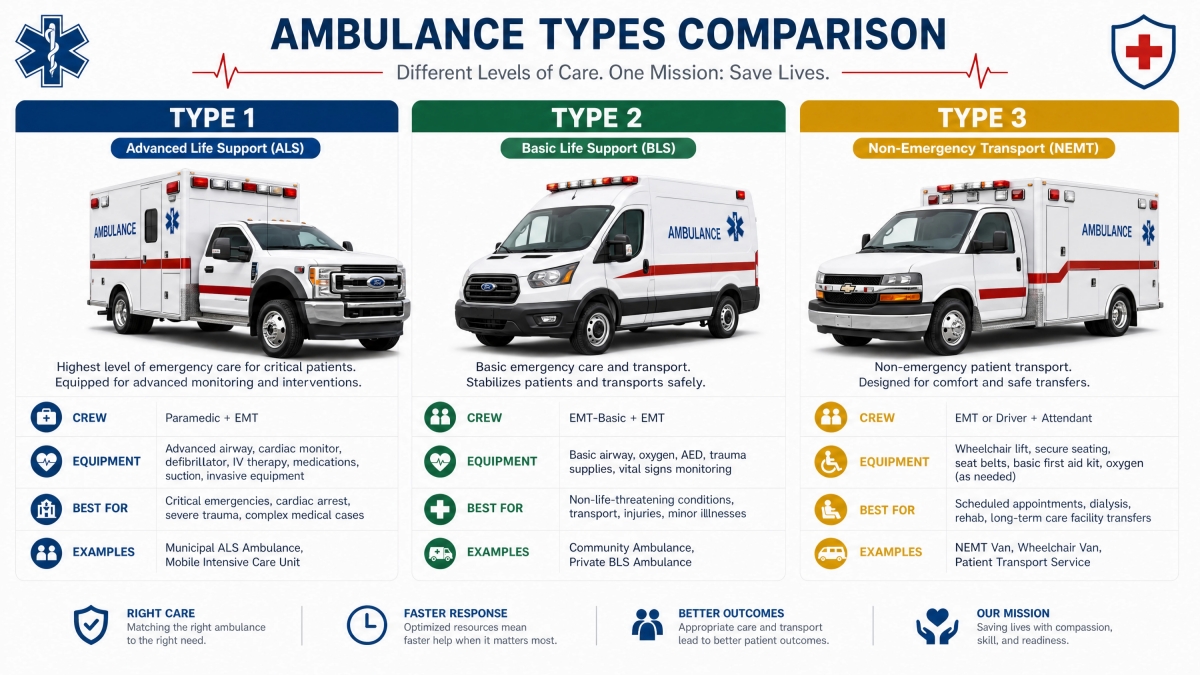
These product categories can correspond to different ambulance types depending on the chassis, cabin layout, and medical configuration.
The Type 1, Type 2, and Type 3 classification is commonly used in North America and many export ambulance markets. It mainly describes the vehicle body and chassis structure.
Type 1 ambulance: Truck chassis with a separate modular ambulance box.
Type 2 ambulance: Van-based ambulance.
Type 3 ambulance: Cutaway van chassis with a modular ambulance box connected to the cab.
A Type 1 ambulance is built on a truck-style chassis. The driver cab and medical module are separate sections, although they may have a pass-through connection.
Type 1 ambulances are usually selected for demanding emergency medical services, such often referred to as advanced life support ambulance. Their truck chassis allows them to carry heavier medical systems, more personnel, larger oxygen systems, advanced communication devices, and rescue tools. They are commonly used in urban EMS fleets, rural emergency rescue, disaster response, and critical care transport.
Type 1 ambulances are suitable for:
Advanced Life Support emergency response
ICU or critical care patient transfer
Long-distance emergency transport
Areas requiring rugged vehicle performance
EMS fleets needing high durability and long service life
A Type 1 vehicle may correspond well with ALS ambulance, ICU ambulance, or negative pressure ICU ambulance configurations.
A Type 2 ambulance is based on a van body. Unlike Type 1 and Type 3 models, it does not have a separate modular ambulance box. The medical area is integrated into the van’s original body.
The greatest advantages of Type 2 ambulances are maneuverability, lower cost, fuel efficiency, and easier parking. They are especially useful in crowded cities, narrow streets, community health systems, airport facilities, industrial sites, and non-emergency patient transport.
However, Type 2 ambulances usually have less interior space than Type 1 or Type 3 vehicles. This means they are often better suited for Basic Life Support or routine medical transport rather than complex ICU-level care. That said, a well-designed Type 2 ambulance can still include essential emergency equipment such as a stretcher, oxygen system, suction unit, basic monitoring equipment, first-aid cabinets, warning lights, and communication systems.
Type 2 ambulances are suitable for:
Basic Life Support patient transport
Non-emergency medical transfer
Community healthcare response
A Type 2 ambulance can correspond well with APK's Basic Life Support ambulance vehicle, right-hand-drive ambulance, and certain electric ambulance applications where compactness and efficiency are priorities.
A Type 3 ambulance is built on a cutaway van chassis, a flexible solution for urban settings. It has a modular ambulance body like a Type 1, but the cab and medical module are generally more integrated. There is often easier access between the driver cab and patient compartment
Type 3 ambulances offer a balance between the heavy-duty capacity of Type 1 and the maneuverability of Type 2. They usually provide more medical workspace than a van ambulance while remaining easier to drive than larger truck-based units.
This type is widely used for both ALS and BLS services, inter-hospital transfer, private ambulance fleets, and municipal EMS. Because of the modular box, the medical cabin can be designed for organized storage, better patient access, stretcher loading systems, advanced medical equipment, and communication technology.
Type 3 ambulances are suitable for:
Advanced Life Support response
Municipal emergency medical services
Inter-facility patient transfer
Medium-duty critical care transport
Smart ambulance and telemedicine applications
Urban and suburban EMS fleets
A Type 3 ambulance may correspond well with ALS ambulances, ICU ambulances.
Ambulance selection is influenced by national and regional policies. While exact rules differ by country, buyers usually need to consider the following policy and compliance areas:
Many markets refer to ambulance standards such as:
NFPA 1917: Standard for Automotive Ambulances in the United States.
KKK-A-1822: Former U.S. federal ambulance specification, still often referenced.
EN 1789: European standard for medical vehicles and their equipment.
Local Ministry of Health or Department of Transportation ambulance regulations.
These standards may define requirements for vehicle dimensions, warning lights, electrical systems, oxygen installation, stretcher safety, patient compartment layout, crash safety, and medical equipment mounting.
Ambulances may be regulated according to service level:
Type 2 Ambulance (BLS ambulance): Basic airway equipment, oxygen, stretcher, first-aid tools, basic monitoring.
Type 1 Ambulance (ALS ambulance): Defibrillator monitor, ECG, medication storage, airway management, suction, ventilator options.
ICU ambulance: Ventilator, infusion pumps, advanced monitoring, oxygen supply, sometimes ultrasound and telemedicine systems.
Type 1, Type 2, and Type 3 ambulances can be matched with different service modes:
Service Mode | Best Ambulance Type | Explanation |
Basic Life Support | Type 2 or Type 3 | Cost-effective and suitable for stable patients |
Advanced Life Support | Type 1 or Type 3 | More space for paramedics and advanced equipment |
ICU Transport | Type 1 or Type 3 | Requires ventilator, monitoring, pumps, and stable power supply |
Non-Emergency Transfer | Type 2 | Lower cost and easier urban operation |
Based on information from APK's official website, several ambulance examples show how different vehicle types and service levels can be applied:
APK lists a V348 Negative Pressure ICU Ambulance, which is suitable for infectious disease control, critical care transfer, and high-level emergency response. This type of vehicle would typically align with a Type 1 or Type 3 ICU ambulance configuration, depending on chassis and body design.
APK describes a 5G ambulance equipped with ECG machine, defibrillator monitor, ventilator, ultrasound machine, and 5G smart gateway. This vehicle functions like a mobile emergency room and enables real-time communication with hospitals. It is best suited for ALS, ICU, and smart EMS service modes.
APK's Basic Life Support ambulance vehicle category is suitable for routine emergency response, patient transfer, community medical services, and urban healthcare systems. Depending on the body type, this may correspond to a Type 2 or Type 3 ambulance.
When selecting between Type 1, Type 2, and Type 3 ambulances, consider:
1. Patient care level: BLS, ALS, or ICU.
2. Road conditions: City streets, rural roads, mountains, highways.
3. Interior workspace: Number of medical staff and equipment needed.
4. Budget: Purchase cost, maintenance, fuel or electricity.
5. Regulatory compliance: Local ambulance standards and registration rules.
For heavy-duty emergency care, choose Type 1. For compact and economical medical transport, choose Type 2. For balanced EMS capability and customization, choose Type 3.
The difference between Type 1, Type 2, and Type 3 ambulances mainly lies in chassis structure, medical space, payload, and operational purpose. Type 1 ambulances are ideal for high-capacity emergency response and critical care. Type 2 ambulances are compact, economical, and suitable for BLS and non-emergency transport. Type 3 ambulances provide a strong balance between space, comfort, and advanced medical capability.