
Tel:
+86 15680081222
When people think of emergency medical services (EMS), their first impression is often simply the ambulance. However, as the scope of pre-hospital care and emergency responses to public health incidents expands, the development of modern EMS systems has moved far beyond the traditional notion of merely acquiring vehicles and equipping them with medical gear. No matter how superior the performance of an individual vehicle or piece of equipment may be, if the vehicle, equipment, and information systems remain isolated and unable to coordinate, they cannot support the standardized, highly efficient care required by modern EMS.
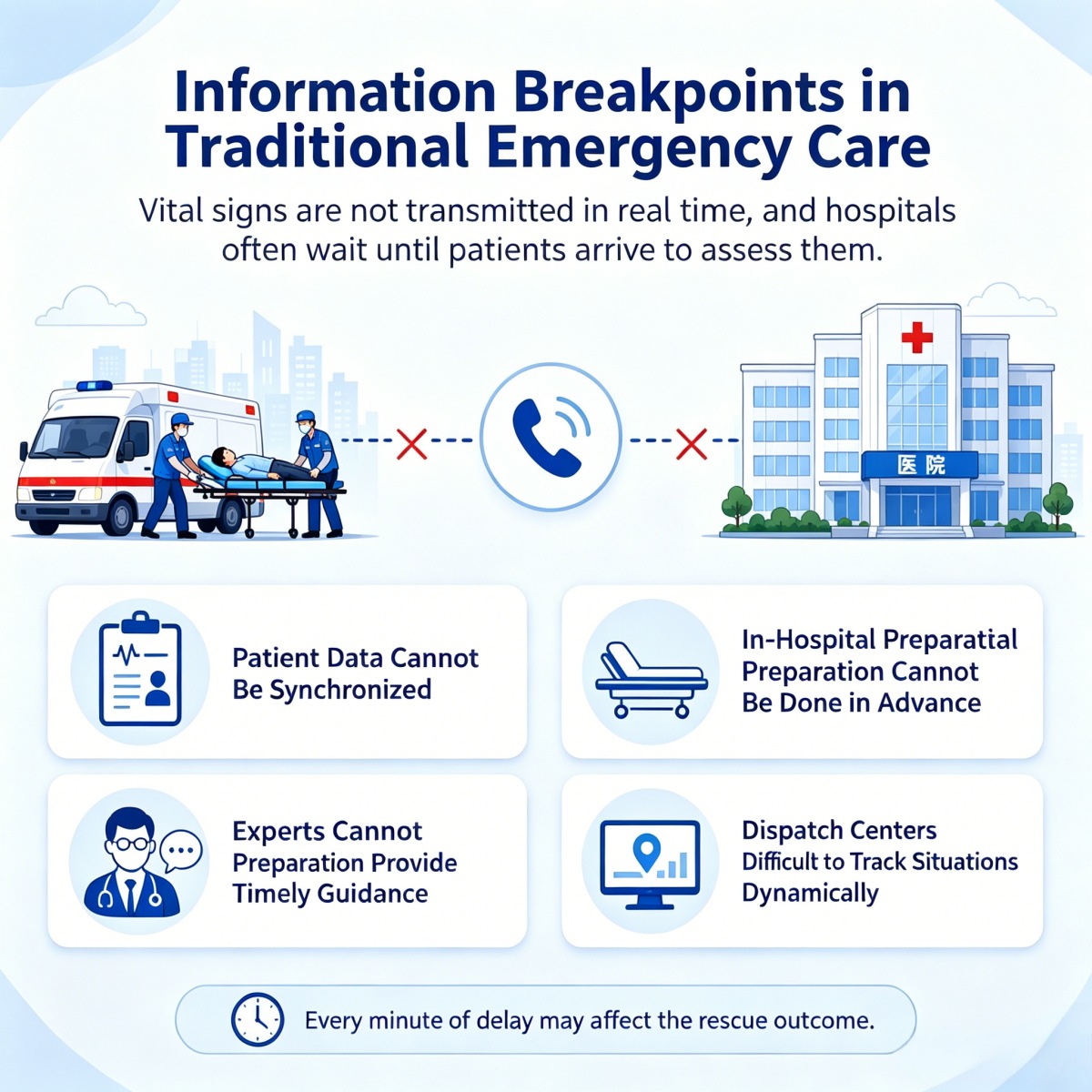
In traditional pre-hospital care models, EMS personnel rely on clinical experience and onboard equipment to provide on-site treatment, communicating patient status to the receiving hospital only via verbal telephone reports. Real-time vital signs cannot be transmitted synchronously; hospitals must wait for the patient to arrive before assessing their condition and preparing treatment resources.
This results in several critical gaps in care: a lack of synchronization between pre-hospital and in-hospital patient data, an inability for medical institutions to make advance preparations for patient reception, the absence of real-time remote expert guidance, and an inability for EMS dispatch centers to dynamically monitor the entire emergency response process. Since every second counts in emergency care, time lost due to information lag can easily lead to missing the "golden window" for treatment.
The core of next-generation smart EMS is the creation of a synergistic, closed-loop system integrating vehicles, equipment, and information systems:
Ambulances: Mobile emergency treatment platforms
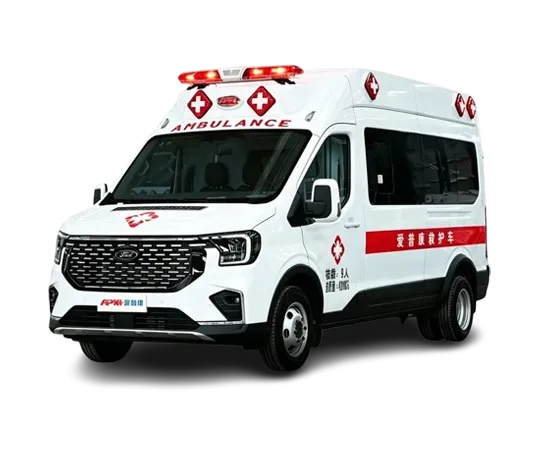
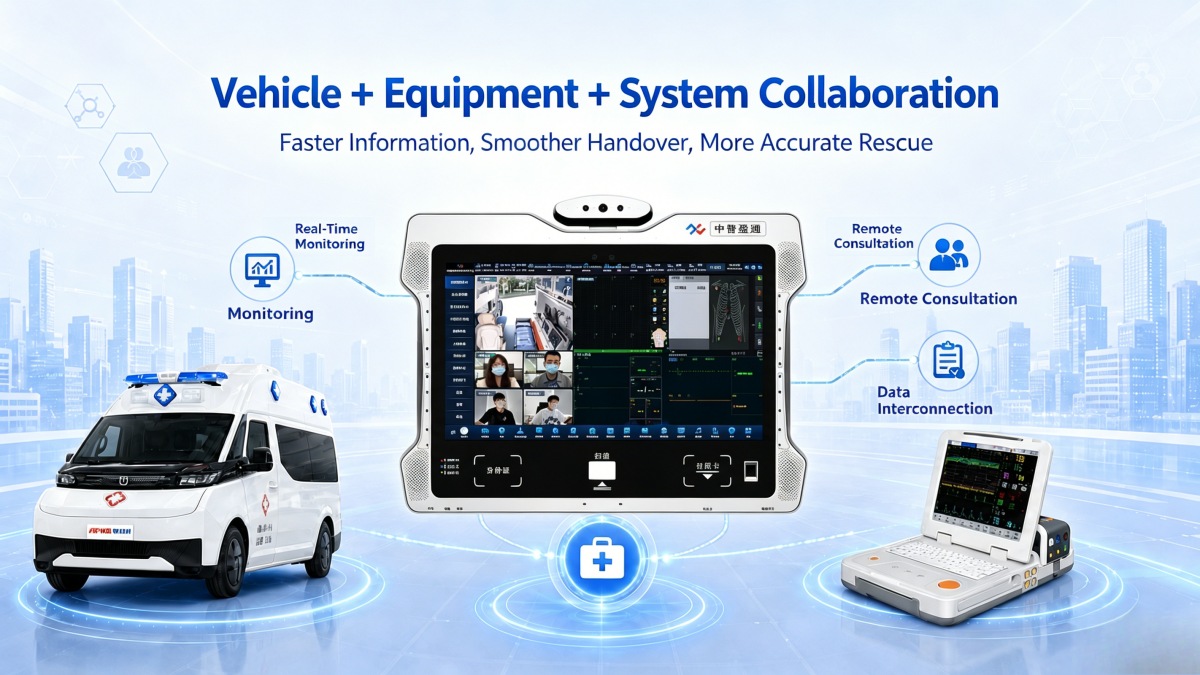
Ambulances are no longer limited to the function of patient transport. Leveraging onboard 5G communication hardware, they transform into mobile medical units that integrate on-site treatment, real-time communication, and data exchange, maintaining continuous connectivity with the EMS command center and the destination hospital while en route.
Medical equipment: Front-end data collection terminals
Diagnostic and monitoring equipment—such as patient monitors, defibrillators, and ECG machines—connect to an integrated 5G smart gateway. Data collected on-site (including blood oxygen levels, ECG readings, and vital signs) is transmitted back to the hospital in real-time. This allows doctors to assess the patient's condition and reserve hospital beds and surgical resources in advance, truly realizing the concept of "information arriving before the patient." Emergency Medical Service (EMS) Systems: A Hub for Region-Wide Collaborative Dispatch
This professional EMS management system integrates functions such as vehicle tracking, mission management, and data interoperability between pre-hospital and in-hospital settings. It coordinates EMS resources across the entire region, seamlessly connecting the full chain of operations—from on-site treatment and patient transport to hospital admission.
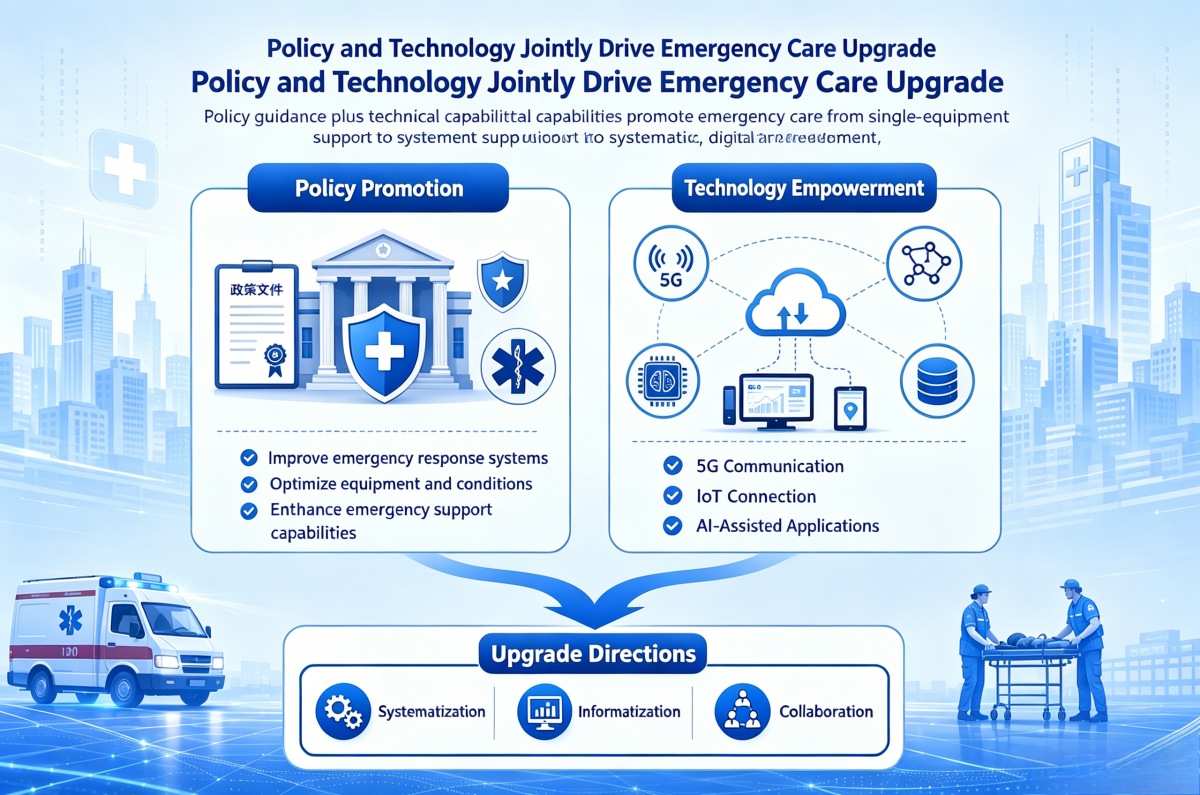
In recent years, the government has issued a series of policies to ramp up the development of pre-hospital EMS systems, explicitly calling for improved equipment allocation and the implementation of digital information systems. Simultaneously, the maturation of digital technologies—such as 5G, the Internet of Things (IoT), and artificial intelligence—has provided the technical foundation for cross-platform connectivity among vehicles, medical equipment, and information systems. Driven by both policy guidance and technological innovation, the domestic EMS sector is shifting away from a fragmented, rudimentary model of equipment procurement toward a systematic, digitized, and collaborative approach.
The speed of a single vehicle and the capabilities of individual pieces of equipment have their limits. A truly efficient EMS system does not merely seek optimization at isolated points; rather, it pursues seamless collaboration across the entire "vehicle-equipment-system" chain.
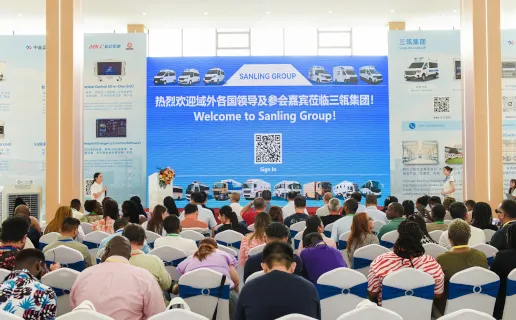
Focusing on diverse application scenarios—including pre-hospital EMS, mobile healthcare, and grassroots emergency response—Sanling Group leverages its comprehensive industry-chain capabilities (spanning specialized EMS vehicles, 5G communication gear, medical equipment, and information systems). The Group continues to drive the integrated deployment of "vehicle + equipment + system" solutions, providing regions with one-stop, systematic solutions for building robust EMS infrastructures.

PREV
