







Tel:
+86 15680081222
In the event of a disaster, an emergency command center serves not only as a hub for information aggregation but also as the "command nerve center" for rescue operations. The quality of its construction directly determines the efficiency of emergency response and the capacity for coordinated action.
Recently, the Ministry of Emergency Management issued Announcement No. 4 of 2026, officially approving the industry standard titled *Basic Requirements for the Construction of Local Emergency Command Centers*. This standard outlines systematic requirements spanning facility construction, equipment configuration, data systems, and operational support, thereby driving the upgrade of local emergency command systems toward greater standardization, digitalization, and systemic integration.
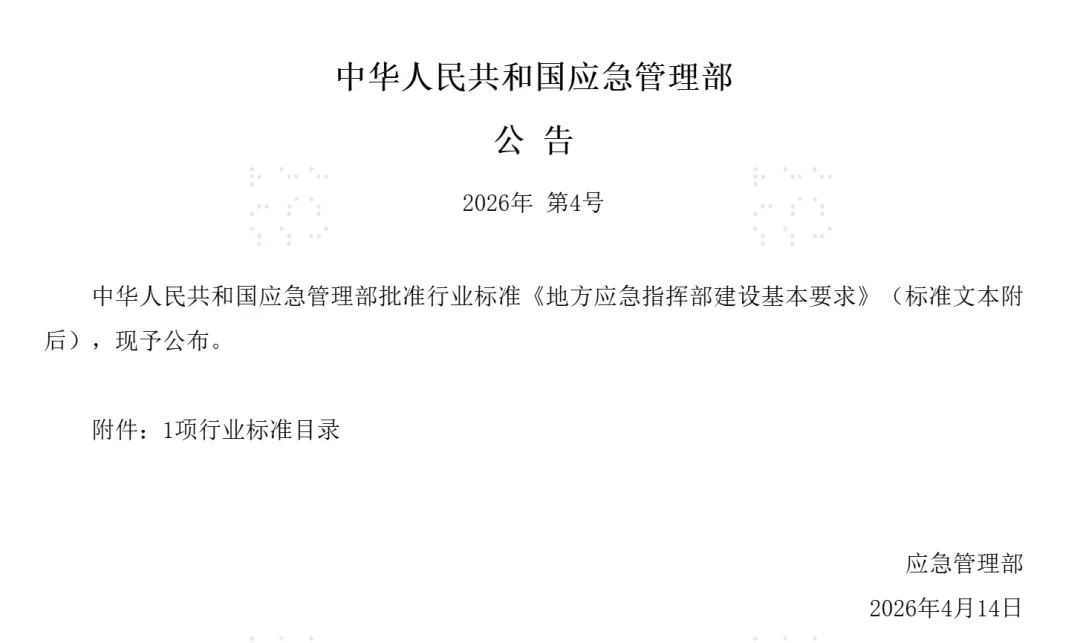
The *Basic Requirements* stipulates that the construction of emergency command centers must adhere to the following principles:
**Vertical Integration and Layered Responsibility:** Establish an integrated command system spanning national, provincial, municipal, and county levels.
**Integrated Response and Local Adaptation:** Coordinate both hardware and software development; industrial parks, townships, and sub-districts may adopt these guidelines as a reference.
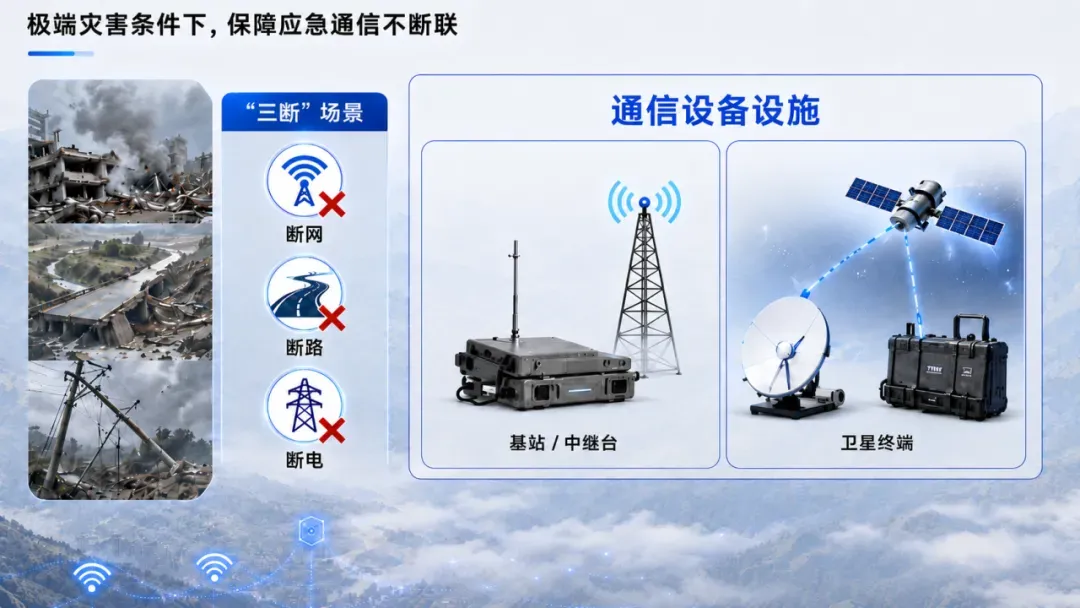
**Combat-Ready Standards and Lean Efficiency:** Ensure uninterrupted command capabilities even under extreme conditions involving outages in communication networks, transportation routes, or power supplies.
**Digital and Intelligent Empowerment; Information Sharing:** Promote the aggregation and integration of data from multiple departments to support joint consultations and unified dispatching.
It is evident that future emergency system development will no longer focus merely on the construction of isolated physical facilities, but will instead place greater emphasis on the holistic coordination capabilities of "Communication + Data + Command."

The standard places particular emphasis on communication assurance capabilities under extreme disaster conditions, requiring emergency command centers at all levels to possess stable and reliable emergency communication assets. These include:
**Deployment of equipment** such as 370 MHz trunked radio systems and satellite communication terminals to ensure uninterrupted communication during critical moments.
**Configuration of on-site audio-visual capture and transmission equipment**—including devices for information collection, data transmission, on-site command, and auxiliary support—tailored to actual operational requirements. ✧ Stockpile and centrally dispatch critical communication equipment, including portable satellite stations, self-organizing network devices, and BeiDou terminals.
The standards mandate that the Command Center aggregate operational data—encompassing detection and sensing inputs, risk and hazard assessments, and facility baseline information—collected by various departments such as public security, fire services, healthcare, meteorology, and water management. Through data sharing and operational collaboration, this initiative aims to further enhance the efficiency of disaster assessment, command and dispatch operations, and cross-departmental coordination.

Spanning everything from physical facilities to equipment, and from data to institutional protocols, the new standards provide a clear "blueprint" for the construction of emergency command systems. However, the true implementation of these standards relies inextricably on professional equipment support and systematic service guarantees—precisely the areas in which Sanling Group has long specialized.
Focusing on the emergency response and first aid sector, Sanling Group has established a comprehensive business ecosystem covering specialized vehicles, 5G communication hardware, mobile medical equipment, operational information systems, and after-sales services. This enables the Group to provide emergency command centers at all levels with integrated support—ranging from hardware to software, and from products to services—thereby facilitating the continuous evolution of emergency command systems toward greater efficiency and enhanced collaboration.
This article has been compiled and shared based on relevant content from the *Basic Requirements for the Construction of Local Emergency Command Centers*, issued by the Ministry of Emergency Management.